The First Hit
I’ve never been the best at any one thing, but I’ve always been good at just about everything. Five years ago, some might have called that a weakness. Today, it’s my advantage. If you’re wired like me, AI feels like the great equalizer. Pure potential. Raw. Uncut. Like many of you, I turned to it to save time. But what started out as efficiency became something else entirely. AI wasn’t a shortcut. It was a surge. Sharpe, confident, unstoppable. The world opened before you got to exhale.
With the right prompts, it exposed the limits of my creativity, then gave me a creative way to break past them. That feeling, that rush of seeing something you imagined reflect back sharper, bolder, faster, was intoxicating.
This white paper explores how artificial intelligence is re-shaping the creative process. Not by replacing us, but by altering us. Before AI, I never thought of myself as a writer. I had ideas, I had taste, but rarely put them to paper. Now, I write production-ready scripts that multibillion-dollar brands actually buy. AI didn’t just expand what I could do, it rewired what I wanted to do. The rush began to settle into rhythm.
Chasing the feeling
Once I understood what AI could do, I started integrating it into new areas of my creative process.
What took weeks, now took hours. I could test ten ideas where I used to chase one. The proof came fast And with it, the familiar pulse of that first rush.
In late 2024, a Fortune-level tech company hired us to shoot B-roll for their new hardware launch. But I didn’t stop at the brief. Instead of just directing and producing, I used AI to build an entire campaign.
Concepts, scripts, visuals, all within forty eight hours. Everytime I pushed it, the feeling came back. That moment when the world tilts. This was when I saw AI’s real power. With the right prompt, I can open any creative door. The challenge isn’t finding the door, it was staying in the chair long enough to decide the right one to walk through.
The Director’s Cut
Once speed became the baseline, a new challenge surfaced. Control. The high of an acceleration brought a new type of chaos. AI could spin more ideas in an hour than I could execute in a week, but many of them were noise. I realized that AI doesn’t have taste, people do. It can show you everything, but it can’t tell you what matters. If I wanted the work to feel alive, I had to direct it. I had to treat it like a first time actor, full of potential, but in need of guidance.
Once I learned to guide it, to speak its language and shape its chaos into something cinematic, everything changed. The better I directed, the better AI performed. My taste became the compass. That’s when the questions started. What if I used that same creative chemistry not to just sell, but connect. I’d directed commercial work and produced assets for the world’s biggest brands before, but this was different. This was personal.
Could this new collaborator help me move beyond simply selling products and start telling stories that help companies connect with people on a deeper level?Stories that resonate not only in market, but in memory. Stories that inspire loyalty, strengthen culture, and build lasting brand communities. Purpose driven narratives that don’t just sell an idea, but sustain a relationship.
As AI continues to reshape how the world works, brands that master this balance between data and emotion will define the next era of connection. That question stayed with me. Could we build a narrative that helps a company connect more deeply with their audience? Something emotional, cinematic, and still tied to their product. That idea became the spark for an experiment.
Proof of Life
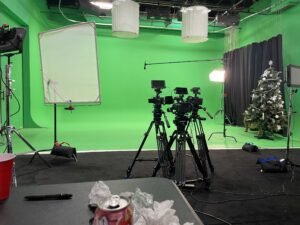
Armed with the knowledge of what AI could help me do, I dove headfirst into writing. Ideas flowed. Dialogue was written, then reworked. Fifteen revisions later, I had a script I believed in. Could I have finished faster? Probably. But if I had, I might never have found my voice. Before AI, I didn’t fully understand long form story structure, but through this digital collaborator, I learned the discipline. I learned the patience to refine an idea until it sang to me. AI gave me speed. Repetition gave me craft. The project became Amy. It wasn’t just a story, It was proof that branded content could live with purpose. Casting was easy. I own a talent management company. Production came naturally, my team and I have produced assets for Amazon, Paramount…We filmed over four seven-hour days with a team that ranged from three to ten crew, balancing ambition with agility. When Amy wrapped, I knew I had created something rare. A project that fused art, purpose, and innovation. Then something unexpected happened.
Two weeks after finishing the edit, my company was approached to adapt a feature length screen play and to shoot another POC. Three weeks later, a tech company reached out about a long term partnership to direct and produce narrative shorts. Luckily I had Amy to show them. The first company hired us after watching it. They handed me a ninety page script, and in 3 days, I turned it into a 14 page proof of concept. Ten revisions later, we had a new project ready to shoot, and it’s damn good.
Can AI make me the next Chris Nolan? Of course not. There will never be another Nolan, Cameron, or Spielberg. Cinema has changed forever. The days of 150 person crews are fading. But can AI help me tell stories that move people the way theirs did? I’d bet everything on it.
The Signal
Over the next few months, my team and I will share scenes from Amy and show how AI shaped the process, from development through post. We’ll also demonstrate how newer tools are helping us enhance the project without reshoots.The story stays the same, but the craft will continue to evolve as technology does. Each update, proof of what’s possible when creativity keeps pace with innovation. The industry is changing fast. Some roles will evolve, others will disappear. But opportunity always follows innovation. I shot Amy with a crew of three on light days and ten on heavy ones, a scale that would have been impossible a few years ago. The same principals that made that possible will shape the next generation of production. Those who master every step, development through delivery, will lead the way forward.
No matter how advanced the tools become, taste, empathy, and intuition remain irreplaceable.
Technology can assist, but it can’t feel, and that’s what makes us storytellers. The future belongs to thosewho merge emotion with intelligence, instinct with data, and artistry with automation. Creativity will always meet the limits of time and budget, but AI allows us to push those boundaries farther than ever before. Amy is proof of that. The goal isn’t to replace creatives with the algorithm, it’s to define a new standard for what’s possible when the two create together.
The initial hit that once felt like speed, now feels like focus. A blur that comes to focus showing not just who we are, but who we are capable of becoming. More aware. More alive. Confidence not born from illusion, but from clarity. A higher state, where instinct aligns with intelligence, and every choice moves one step closer to perfection