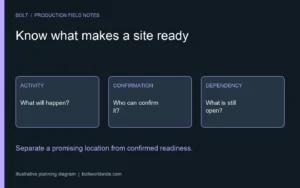
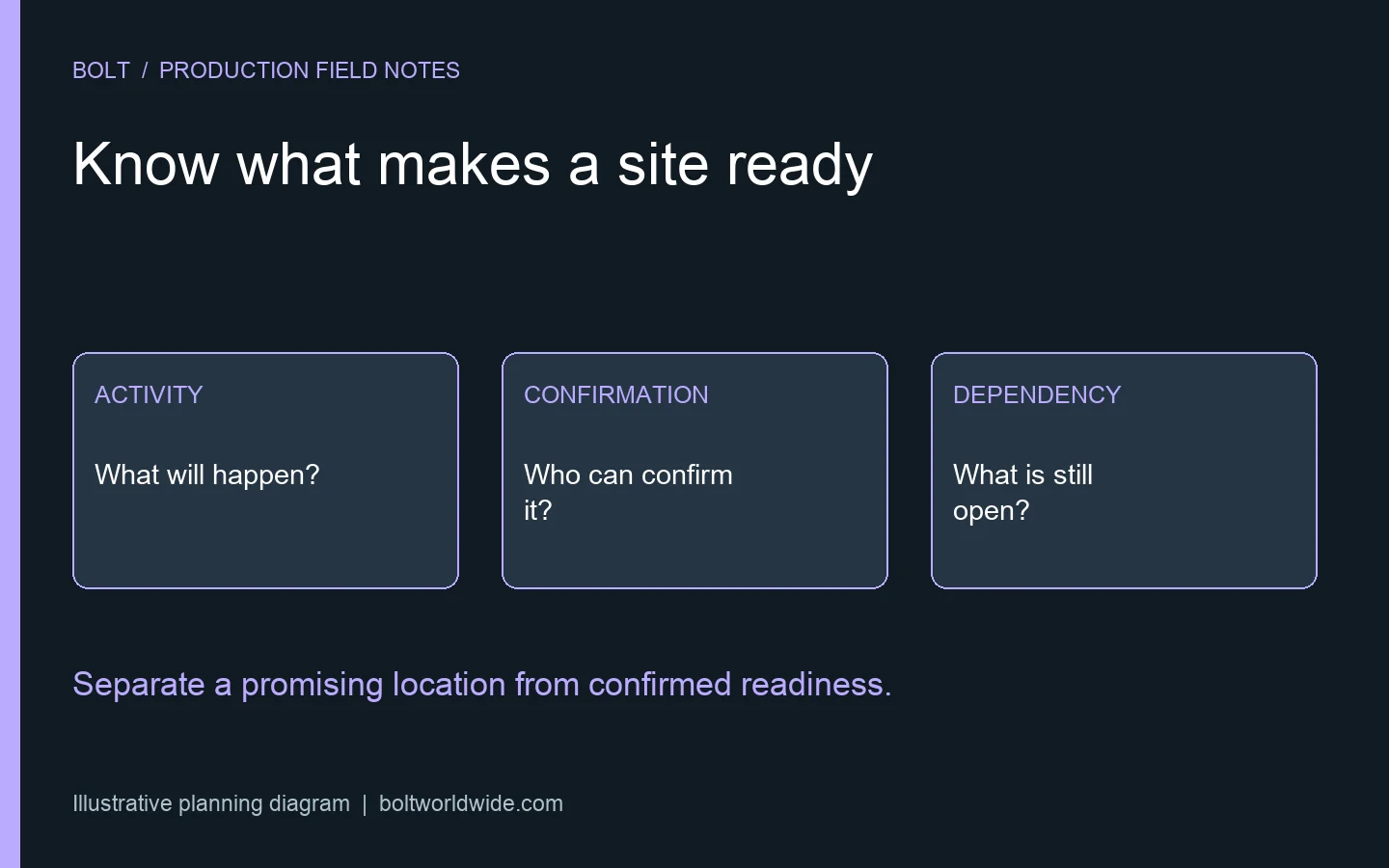
Before calling a filming location ready, confirm the actual activity, the people authorized to approve it, the access arrangements and the practical conditions the production needs. Record what is confirmed and what remains dependent on another decision. A promising scout, an available room and permission to proceed are different milestones.
This is a buyer-side readiness check for a brand or agency preparing a shoot. It is not a permit determination or a substitute for the responsible production team and authorities reviewing the project. The useful question is what evidence supports putting this location into the working schedule, rather than whether someone has said the place looks good.
Describe the activity as well as the address
Start with what will happen at the site. Identify the scenes, people, equipment, working areas and proposed access times. Include preparation and removal, not only the moment the camera records. Explain any activity outside the principal room, such as loading, holding or moving equipment between spaces, so it can be considered in the plan.
For an invented example, a company may offer a conference room for an interview. The production still needs to understand who can enter the building, where equipment arrives and whether nearby business activity affects the recording. If additional footage is proposed in a shared corridor, include that explicitly rather than treating the original room discussion as an answer for the whole building.
Put the relevant details in the production brief. A location description should remain connected to the current creative. If a later shot adds another area or changes the activity, raise that change with the responsible people. Do not assume an earlier confirmation automatically covers the revised plan.
Identify who can confirm each requirement
Distinguish the people managing the property from any authorities responsible for the proposed activity. In its current film locations guidance, the Georgia Department of Economic Development says the Georgia Film Office does not issue permits. It identifies local governments and other relevant agencies as the bodies that determine permitting requirements, with county liaisons available to help establish the local process.
For a Georgia shoot, use that guidance to find the responsible route for the actual location and activity. Do not take a statewide directory listing as approval to film. Likewise, a contact offering access may still need to involve the person authorized to agree the arrangements. Ask the production lead to identify which confirmations are needed and who will obtain them.
Avoid using an old article’s fee or turnaround claim to make the schedule. Current project requirements belong with the relevant authority and responsible reviewers. This guide provides no universal permit price, lead time or exemption. The planning task is to make outstanding confirmation visible before the brand or agency relies on the location.
Separate a promising scout from a practical production plan
A creative scout asks whether the place can support the story. The production team also needs to evaluate how the work would happen there. Our existing pre-production guide distinguishes location scouting from a technical scout. Build on that distinction by asking what remains unresolved after the first visit.
Discuss sound, working space, power arrangements, access routes and where people can wait without obstructing the site. Ask the responsible team what it needs to verify rather than deciding technical suitability from photographs. A visually attractive room may require a different plan once the actual recording conditions are understood.
Review the location with the relevant production and site contacts together when practical. That conversation can reveal a misunderstanding while there is still a choice about the setup. The brand does not need to prescribe technical solutions. It needs to know which dependencies could change the creative, scope or date and who owns the next check.
Match access to the full working day
Write down when the team can arrive, prepare, film and remove its equipment. Identify the person who can provide access at each point and what happens if that person is unavailable. A calendar reservation may describe room use without addressing the production’s other needs. Confirm the practical arrangement rather than letting different teams interpret the booking differently.
Discuss shared areas and ongoing operations with the site contact. What activity continues during the proposed shoot? Which areas need to remain available to other people? Where can materials be staged? These are questions for the actual site plan. They are not reasons to assume the production can stop normal activity or direct unrelated people without agreement.
For a project across several locations, use the multi-city shoot planning guide to keep the shared creative separate from local arrangements. A confirmation for one site does not establish readiness at another. Keep a clear owner and status for each location-specific dependency.
Keep a short record of confirmations and open questions
Use a simple record naming the requirement, the person responsible, the supporting confirmation and the next action. Keep tentative availability distinct from confirmed access. Keep a submitted request distinct from an approval. The exact documents depend on the project, but their status should be understandable to the people deciding whether the schedule can proceed.
Include conditions and limitations with the confirmation. A permitted area, agreed activity or access period should not be reduced to a green status with the detail removed. Identify who checks that the working plan still matches those conditions. Store only information the team is authorized to hold and share it through the appropriate project process.
Review what would trigger another check: a different scene, a changed date, another area or new equipment requirements. Do not allow a revised creative to circulate separately from the people managing the site arrangements. A clear change process can reveal that something needs review without turning every production conversation into an unnecessary restart.
Decide what happens if a dependency remains open
Ask the production lead to explain the alternatives before a location uncertainty becomes a last-minute assumption. The answer may involve another setup, a different site, a revised schedule or a smaller piece of work. Evaluate the effect on the story and remaining deliverables rather than choosing an alternative only because it is available.
Do not treat silence as confirmation. If an essential requirement is still unresolved, record that status and name who will make the next decision. The responsible team should determine whether the project can proceed under its actual conditions. The purpose of a readiness check is to expose a missing answer, not create a document that makes an unconfirmed plan appear settled.
Email brian@boltworldwide.com with the proposed location, creative, access information and open dependencies. Bolt’s pre-production services provide a starting point for planning the work. Begin with the activity and confirmations, then decide what the schedule can responsibly rely on.