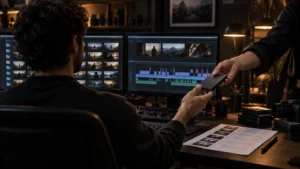

Review a corporate video script by checking what the audience will understand, what supports each claim, what the camera will show and whether the spoken delivery fits the intended film. Read the words aloud, pair them with the proposed pictures and identify unresolved decisions. Approve a specific version only when the message and the work needed to film it are clear.
A script can sound polished in a document and still leave the production team with an unanswered question: what are we actually shooting? The approval conversation should connect the writing to the viewer’s experience and the practical production plan.
Read for the audience before editing individual words
Write the viewer’s main question above the script. Then read the opening without the internal background your team already knows. Does it explain a recognizable situation, establish a useful promise or show something the viewer needs to understand?
Compare the script with the agreed video production brief. If the audience or objective has changed, resolve that change before polishing lines. A stakeholder’s favorite phrase is not a reason to introduce a second competing message.
Put pictures beside the spoken words
Ask for a clear description of the proposed visual action beside each section of narration or dialogue. Identify what is filmed, what is supplied by the client and what must be created in post-production. A phrase such as innovation in action does not tell a crew which action will demonstrate it.
Consider a hypothetical product film. If the script says the tool simplifies a task, the visual plan should identify the task and the action viewers will see. If the process cannot be demonstrated, discuss a different explanation rather than leaving the editor to invent proof from unrelated footage.
Bolt’s scriptwriting service connects the written idea to the project. Use the review to clarify the story and its production requirements together.
Read it aloud at an honest pace
Have someone read the script naturally, including pauses needed for an explanation, a reaction or a visual demonstration. Listen for language that works on a page but feels difficult to say. Mark acronyms and pronunciations that need guidance.
Time the reading as a planning check, then discuss the additional screen time the pictures require. Do not assume a fast read proves the finished video will fit. A demonstration, an on-screen label and a closing action may need room beyond the spoken sentence.
Give each claim an accountable reviewer
Highlight statements about product capabilities, customer experience or business results. Identify the person who can verify each statement and the material supporting it. Mark qualifications that must remain attached to the message.
An appealing sentence is not evidence. If a claim remains unresolved, revise the wording or hold that section for verification. Do not let an unconfirmed line become a filming requirement simply because the document looks finished.
Check what approval commits the team to film
Review locations, people, products, demonstrations, graphics and supplied assets implied by the script. Ask which are available and which still depend on a decision. A new scene or an additional speaker may change scope, scheduling or cost.
Use the creative development guide for the broader relationship between objective and story. This checkpoint is more specific: can the agreed story be produced with the resources and responsibilities in the current plan?
Return decisions against a named version
Consolidate comments before sending them back. Distinguish a factual correction, an audience problem and a preference about tone. Where reviewers disagree, explain the decision needed instead of asking the writer to satisfy incompatible requests.
Our guide to keeping video approvals moving covers ownership of that process. Record which script version was approved and list any conditions still open before filming.
Do we need to approve every camera angle in the script?
Not necessarily. Agree the message, essential action and production requirements at the appropriate level of detail. The director can develop the visual execution, but material assumptions should not remain hidden until the shoot.
What if the script changes after approval?
Ask what the change affects before proceeding. Recheck the facts, visuals, required people and delivery plan. A previous approval does not automatically cover a new claim or scene.
Email brian@boltworldwide.com with your brief, current script and production deadline. The useful question is not whether everyone likes the document. It is whether everyone understands the film they are approving.