
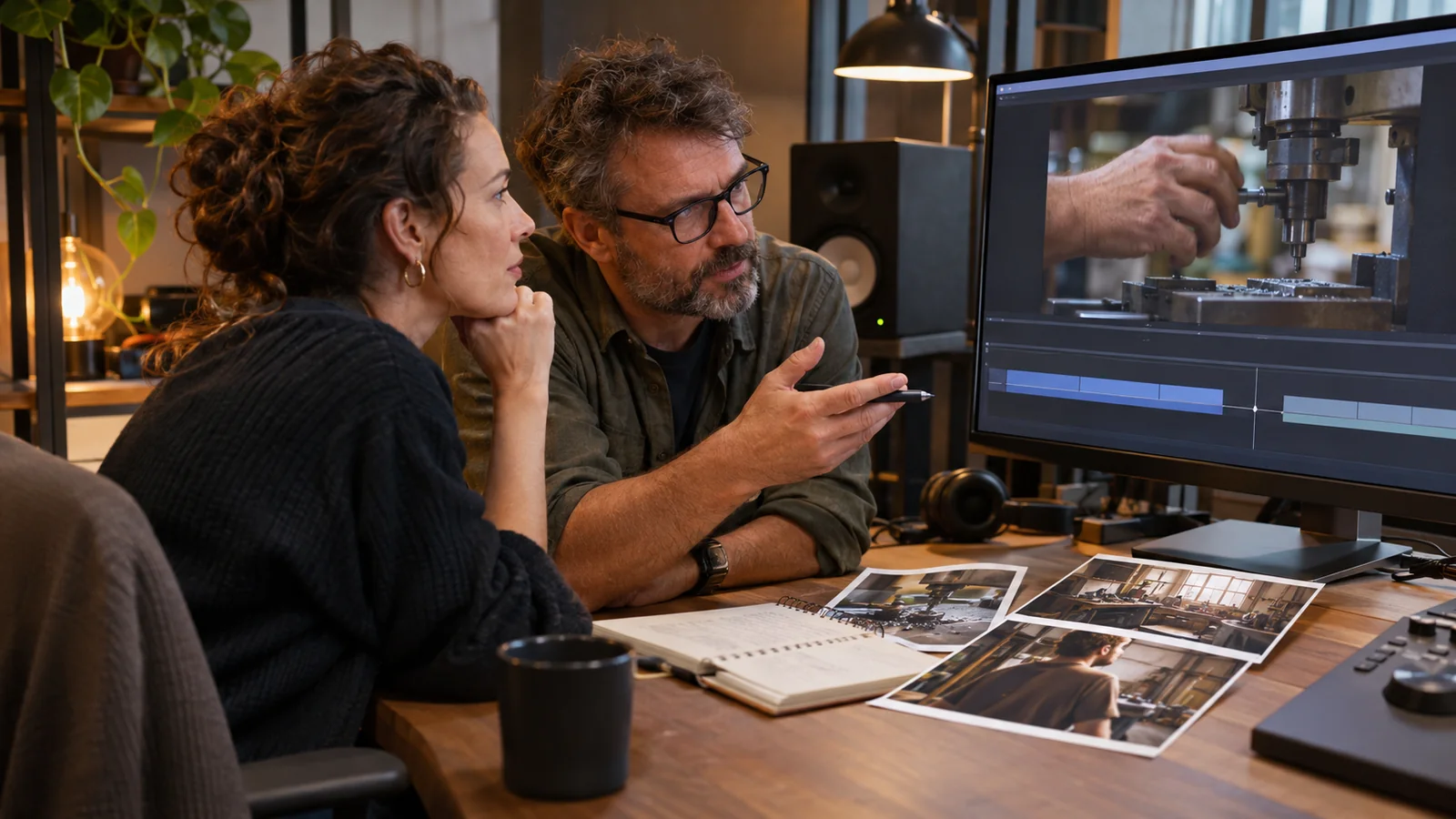
Plan additional filming after a first cut by identifying the exact information the edit cannot currently show, checking what usable material already exists and agreeing the smallest new filming assignment that resolves the gap. Have the producer assess access, continuity, scope and timing before booking. A request for more footage should explain what the viewer needs to understand.
Illustrative generated image. This scene does not depict Bolt personnel, facilities or client work.
This guide concerns a new filming decision after recorded material has reached the edit. The editing handoff guide covers preparing material for the first cut. Here the question is whether another production is needed, and what it would actually need to capture.
Describe the missing explanation against an exact cut
Identify the version being reviewed and the moment that feels incomplete. State what the viewer cannot yet see or understand. A request for more energy might concern pacing, performance, music or the chosen shot. Those possibilities require different work. Give the editor a problem to examine before deciding that another shoot is the answer.
For a hypothetical equipment film, the current cut might show a person beginning an adjustment and then a finished result, without showing the intervening action. The question is whether that missing action matters to the explanation. If it does, describe it plainly. Do not ask for several attractive workshop shots and hope one will establish what happened.
Use the video approval workflow to consolidate that decision. Different reviewers may be asking for different films. Resolve the audience and message before turning contradictory notes into a filming list. Reference images can help explain a question without proving that the proposed solution has been accepted.
Ask the editor what the recorded material can support
Ask whether unused takes, alternate angles or other supplied material address the issue. Confirm that the editor has the relevant originals and production notes. A shot missing from the current cut is not necessarily missing from the recorded coverage. Equally, a file in an archive is not automatically suitable for the intended scene.
Have the editor explain the options and their limits. Reordering material may clarify a sequence. Another take may provide a better explanation. An appropriate graphic might support a particular point. None should imply an action, capability or result that the material does not establish. The factual owner still needs to verify the explanation.
Discuss those possibilities through Bolt’s video editing services. The purpose is to understand what a revised edit could reasonably accomplish before commissioning new filming. This does not promise that a missing demonstration can always be repaired in post-production or that a particular change is included in the existing scope.
Separate a correction from a changed assignment
Compare the request with the current agreed brief. Does it concern a missing element of the planned explanation, or a new message someone now wants to introduce? Both may deserve attention, but the production conversation should identify the difference. Do not describe a new audience, product variant or participant as a small correction without assessing what it requires.
For an invented example, a team reviewing a training film may decide that it now needs an opening for customers as well. That is a different use with its own context. Another close view of the existing procedure will not by itself make the original film appropriate for that audience. Decide what the additional version is meant to do.
Ask the producer to explain how the actual agreement treats the proposed work. This guide offers no standard revision allowance, reshoot price or rule about who pays. Agree the revised scope and responsibilities before anyone relies on a date. Record what is being approved rather than let an informal request become an assumed booking.
Build a filming list around the intended edit
For each proposed new scene, describe its purpose and how it connects to the surrounding material. Name the essential action, product state, statement or relationship that must be clear. Include the current edit reference so the director can understand the problem. Leave technical execution with the responsible production team.
Ask whether the new material needs to match an existing scene or can be presented as a separate moment. A close view continuing an action creates different preparation needs from a clearly separate demonstration. The director and editor should discuss what makes the transition understandable, rather than have the client prescribe a camera arrangement from memory.
Keep optional ideas separate from required coverage. A concise assignment should still allow the team to identify the views and context needed to make it editable. The production brief should carry the revised requirement, current references and accountable reviewer. A smaller filming assignment still needs a complete explanation.
Recheck the conditions needed to recreate the moment
Identify which people, products, locations and approved assets are needed. Ask who can confirm availability and any relevant conditions. Something accessible during the original production may no longer be available in the same way. Bring that uncertainty into the schedule discussion instead of assuming the team can simply return.
If continuity matters, gather the approved references showing the relevant clothing, product appearance and arrangement. Explain what must remain consistent and what can differ. The product sample preparation guide covers the physical state of products across takes. Use actual reference material rather than relying on a polished storyboard as proof of what was filmed.
Have the responsible production and site contacts assess the working arrangements. Keep access, technical decisions and the practical suitability of the location with those people. A familiar room or returning participant does not remove the need to confirm the plan for this particular assignment. Identify any condition still waiting for an answer.
Agree how the new material returns to the edit
Tell the editor what is being captured, which version it supports and when the material is expected. Agree how files and notes will be identified and transferred. Preserve the connection between the filming request and the resulting footage so the team can evaluate whether the actual gap has been addressed.
Plan the relevant review after the new material is assembled into the cut. A shot can look suitable by itself while failing to connect clearly to the surrounding sequence. Check meaning, continuity and the factual explanation in context. If the new recording changes a statement or scene order, include the appropriate message owner in that review.
Keep any remaining uncertainty visible. Additional filming is a choice about a particular problem, not a guarantee that every later preference has been settled. Email brian@boltworldwide.com with the current cut, missing information and available references. Discuss the required work with Bolt’s production team before the revised edit depends on unconfirmed footage.