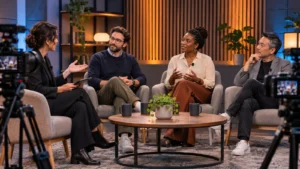
Plan a panel discussion video for shorter clips by choosing the questions each piece should answer, assigning a moderator who can guide the exchange and asking the production team how every speaker will be seen and heard. Agree review responsibilities for the people and organizations involved. A full recording provides source material; it does not guarantee that every answer will work as a standalone clip.
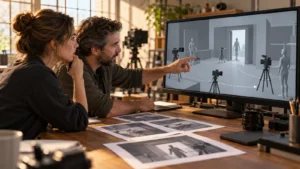
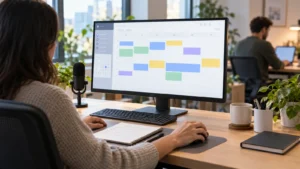
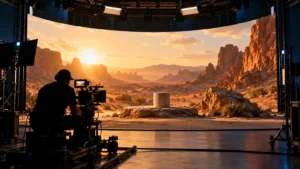
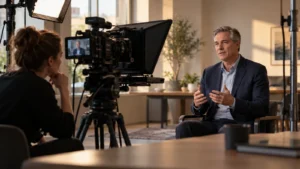
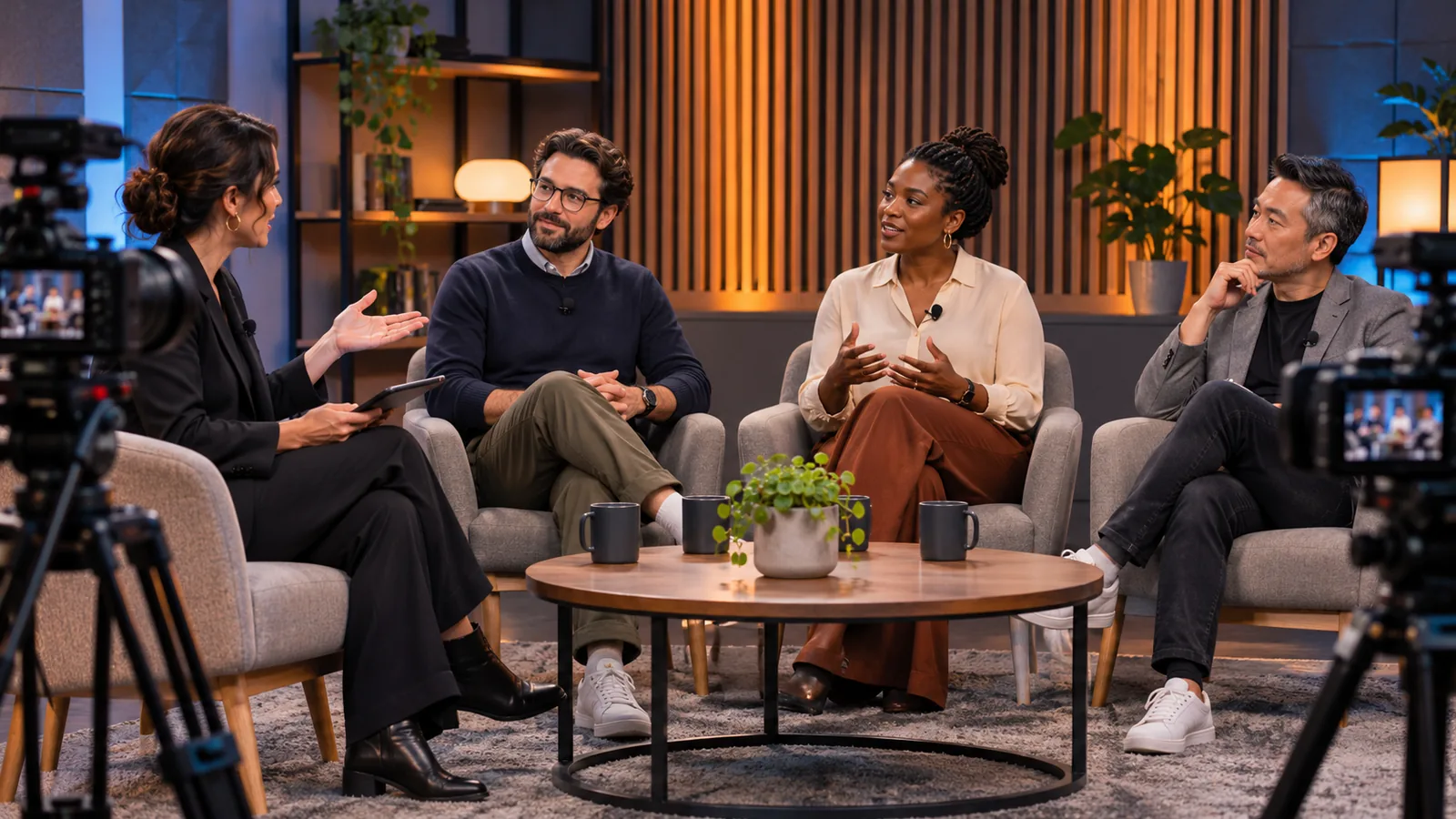
Illustrative generated image. This scene does not depict Bolt personnel, facilities or client work.
This is a commissioning guide for a recorded conversation with several participants. It is not a conference coverage checklist, a live-stream setup or an announcement of a Bolt podcast service. The central decision is how the conversation itself will produce clear, usable explanations without scripting the participants’ opinions.
Give each participant a reason to be in the conversation
Start with the subject and the different perspectives needed to explain it. Ask what each person knows through actual responsibility or experience. A job title may establish a role, but it does not show which question the person can answer in a useful way.
Avoid adding speakers solely to represent every department if the result is several people making the same general point. A smaller discussion with distinct contributions may suit the question better. Ask the producer how the proposed group and available recording time affect the conversation. There is no universal panel size that makes a topic useful.
For a hypothetical discussion about introducing a new customer process, one participant might understand the customer’s difficulty, another the operational change and another the team’s experience using it. Give each an identifiable contribution. Do not invent agreement between them before hearing what they actually think.
Choose what the moderator is responsible for
Decide whether the moderator will appear as a host, act mainly as an interviewer or also contribute subject expertise. Those roles create different demands. Someone expected to present a point of view may need another person to keep the exchange balanced and the questions understandable.
Give the moderator a topic map with the audience’s questions and the limits of each person’s knowledge. Ask them to invite an explanation when someone uses shorthand, distinguish different experiences and return to a question that has not been answered. The aim is to make the reasoning audible, rather than make every participant repeat an approved slogan.
Our employee interview preparation guide covers helping people prepare without memorizing answers. A panel adds a responsibility to notice how one answer changes the next question. Brief the moderator to listen for disagreement and qualification as well as a memorable sentence.
Design questions that can support a short explanation
Describe the audience question for each proposed shorter piece. Then ask whether a participant can reasonably answer it within the conversation. A question such as what changed in a particular workflow creates a clearer assignment than asking for general thoughts about innovation.
Help speakers understand that a viewer may encounter an excerpt before seeing the longer discussion. Encourage clear references to the subject instead of unexplained phrases such as “that issue” or “as we said earlier.” This is a preparation choice, not a requirement to repeat a fixed sentence. Natural answers still need enough context to be understood.
Do not promise a set of finished clips simply because the session lasts a certain length. The usable material depends on the answers, coverage, sound, review and actual scope. Distinguish planned short explanations from additional possibilities the editor may identify after reviewing the recording.
Discuss turn-taking as a production requirement
Ask the team how it will capture the person speaking and the people responding. A wide view can establish the group, while another view may help the editor follow a particular contribution. Let the director and technical team propose the coverage for the room, group and outputs rather than prescribing a camera count from a generic checklist.
Sound deserves the same conversation. Ask how each voice will remain intelligible, how levels will be checked and how interruptions or overlapping speech will be handled. A second camera angle cannot separate two people speaking over each other in an unusable recording. The right setup depends on the actual space and discussion.
Brief participants on a practical signal for entering the conversation and on allowing an answer to finish. A moderator can invite the next view without making the discussion mechanical. If a key explanation is obscured by interruption, ask the person to clarify it during recording rather than assume editing will reconstruct words that were not captured clearly.
Protect the meaning of a multi-person exchange
A panel answer may depend on another person’s question, correction or disagreement. Review the surrounding exchange before lifting a sentence into a short piece. Removing a qualification can change what the speaker appears to claim; removing a disagreement can create the impression of consensus that never existed.
Identify each speaker accurately in the finished clip. Explain their relevant role without suggesting they speak for an organization beyond their authority. If an answer concerns a particular example, keep that boundary clear in the title, captions and accompanying copy as well as the spoken edit.
The event video planning guide discusses the broader difference between full sessions and excerpts. For a panel, add a specific check: does the shorter version preserve the relationship between the views heard? The most forceful line may not be the most faithful explanation of the discussion.
Agree speaker and organization review before recording
Identify who checks factual statements, participant identification and the intended uses of each person’s contribution. If speakers come from different organizations, ask which reviewers need to assess the clips featuring their people. Keep those decisions distinct from a general preference about pacing or music.
Give reviewers the actual proposed excerpt and enough source context to assess it. A timestamp and the relevant surrounding exchange can make a disputed edit easier to examine. Ask them to identify the issue and required correction, rather than request an undefined replacement that the recording may not contain.
Discuss these responsibilities with the video editing team in the scope. Participation in a conversation should not be treated as an assumption that every possible future excerpt or use has been settled. The responsible parties must establish the actual permissions and review requirements.
Plan the full conversation and the clips as related outputs
Decide whether the whole discussion will be released, kept as source material or used for a different audience. A longer version can support context, but linking to it does not excuse a misleading short edit. Each published piece should make sense on its own terms.
List the intended placements early. If the clips need both portrait and landscape versions, use the vertical and horizontal shoot guide to discuss framing before recording. Several people seated across a wide frame can require different planning from a single person in a close shot. Check labels and captions in the actual layouts.
What should the producer receive first?
Send the audience questions, proposed participants, moderator role, recording setting, intended outputs and review contacts. Mark which facts and arrangements remain unconfirmed. Ask the production team to explain how the conversation, coverage and editing plan serve those outputs before treating the recording date as a complete brief.
Email brian@boltworldwide.com with the discussion you want to commission and the shorter explanations you hope it can support. The useful goal is a clear exchange between people with something specific to contribute, captured so the eventual edit can preserve that exchange.