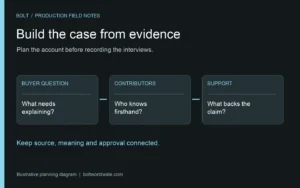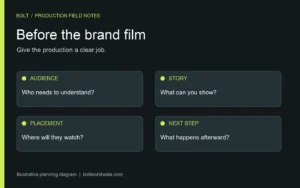
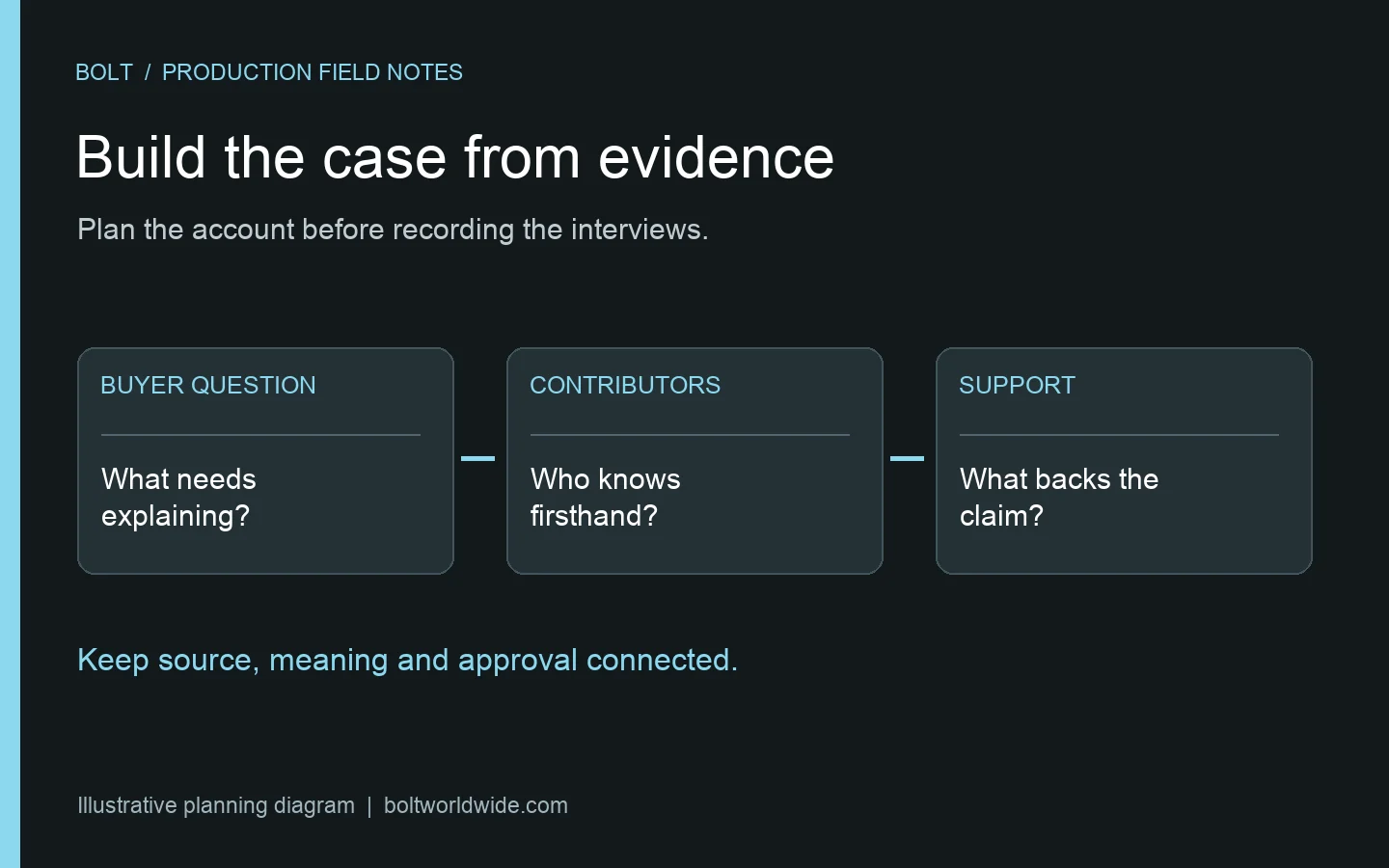
Plan a case study video by choosing the buyer question it must answer, mapping the people who can explain the experience and identifying the evidence behind each important result. Build an interview and footage plan from that map. A set of enthusiastic interviews becomes a useful case study only when the account, supporting material and final claims fit together.
This guide focuses on a story that draws on several contributors or kinds of evidence. Our customer testimonial production guide covers choosing and interviewing a customer. Here, the commissioning question is how to combine different perspectives without presenting an impression as a documented business result.
Choose the decision the case should help a buyer make
Start with a question a prospective customer would reasonably ask. It might concern implementation, the work involved in a transition or how a solution is used in a particular setting. Pick a question the available case can actually address.
Do not choose an outcome first and ask the interviews to prove it. Before committing to the story, check what the customer can discuss, what material exists and which people participated in the work. A compelling account of the process may be more supportable than a headline about a result nobody can document.
Put that decision and the limits of the available case in the production brief. The creative team should be able to distinguish the intended story from facts still being checked.
Give each contributor a clear role in the account
A sponsor may explain why the organization made a change. Someone using the solution may describe the practical experience. A delivery lead may explain the work required. These are possible roles to investigate, not a required cast or a guarantee that their accounts will agree.
Identify what each person knows directly. Ask who can explain the original situation, who saw the change take place and who is responsible for the proposed result. Avoid treating seniority as evidence that a speaker witnessed every part of the story.
Use preparation conversations to uncover differences in perspective. If one person describes an easy transition and another recalls substantial preparation, keep that context available to the interviewer. The purpose is to understand the experience rather than collect matching promotional lines.
Create a claim record the reviewers can use
For each important proposed statement, record who said it, what supports it, the relevant period and who can approve its use. Note qualifications and confidentiality restrictions beside the statement, where the writer and editor will see them.
For a hypothetical software implementation, an employee might describe less repetitive work while the business sponsor reports a change in a tracked measure. Those are different statements. Do not use the employee’s impression as proof of the numerical result, or imply that the software alone caused a change influenced by several factors.
If records cannot be shared publicly, ask the responsible customer reviewer what can be verified and approved. Revise the claim to fit the available support or leave it out. A gap in the evidence should change the proposed story, not become a request for a more confident interview answer.
Plan pictures that explain the account
List the activities, settings, documents or demonstrations that could help a viewer understand the experience. Connect each planned sequence to a part of the account. Confirm access and restrictions with the customer before building the schedule around it.
Distinguish current activity from a reconstruction of an earlier situation. A present-day workflow can help explain a process, but it does not document what happened before the production arrived. Tell the team when footage is illustrative and avoid implying that an ordinary shot proves a business result.
Bring these dependencies into pre-production. If essential material is unavailable, decide whether another approach can explain the case accurately or whether the scope needs to change.
Structure the story around a change the viewer can follow
An initial outline can move through the situation, the decision, the work involved and what happened afterward. Use it to identify missing explanations before filming. Keep room for the interviews to reveal a more accurate account.
The useful sequence is not necessarily the order in which contributors were interviewed. Introduce people and context when the viewer needs them. If accounts differ, resolve the factual question with the responsible reviewer rather than editing the difference out simply to make the story smoother.
Include constraints that materially affect the outcome. A case about a particular team or setting should not silently become a promise about every customer. The viewer needs enough context to judge whether the experience is relevant to their own situation.
Preserve the evidence through editing and shorter versions
Give the video editing team the claim record, source references and approved assets along with the media. Mark unresolved material so a strong line cannot accidentally become an approved claim. Our editing handoff checklist explains the wider delivery conversation.
Review the cut against the original accounts and supporting material. The testimonial cut review guide addresses how editing, graphics and adjacent pictures can change the apparent meaning of a statement. Apply that scrutiny to each contributor and any result introduced by narration or text.
Check shorter excerpts separately. If the full version identifies a particular customer, timeframe or limitation, a social cut may need to retain that information to remain accurate. Match captions and supporting files to the exact approved export. The World Wide Web Consortium’s media planning guidance provides a starting point for discussing accessibility needs before those deliverables become late additions.
Do case study videos need a numerical result?
No. A specific, supported account of a decision, implementation or working experience can be useful without a performance figure. If a number is central to the story, identify its source and the person who can verify its wording and context. Do not insert a figure simply to make the case feel more persuasive.
Who should approve the final case?
Agree responsibility with the customer and commissioning team before filming. Identify who checks factual claims, participant representation, permissions and the intended uses. Keep the approval attached to a named final version. An interviewee agreeing to speak is not evidence that every later edit has been cleared.
Email brian@boltworldwide.com with the buyer question, proposed customer, likely contributors and available supporting material. A strong case study starts with an experience you can explain and evidence you can responsibly use.