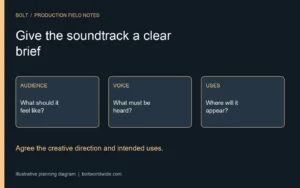
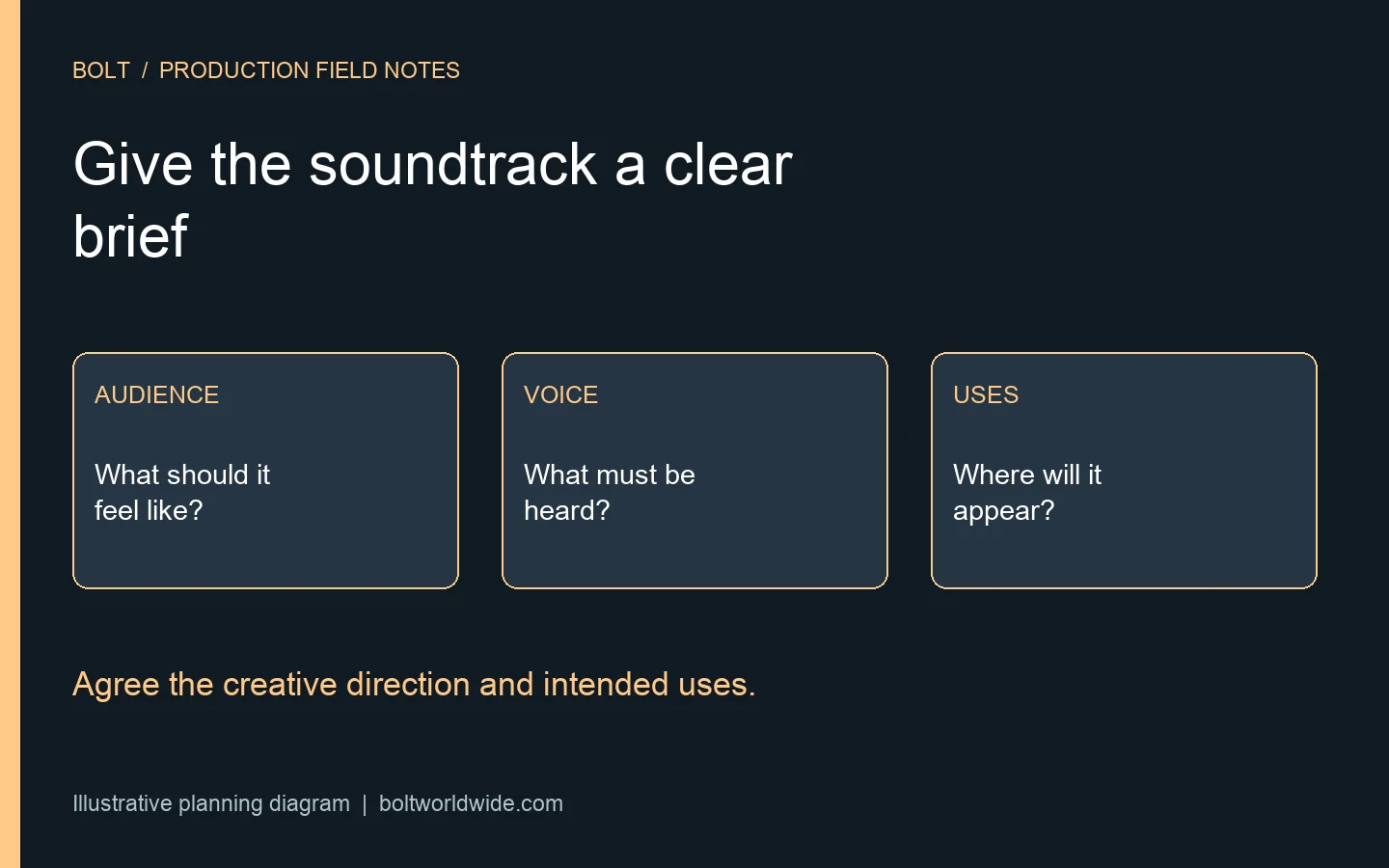
A useful brand video music brief explains what the viewer should feel, how the track should work around speech and where the finished film will appear. Give the editor references with reasons, identify the planned versions and name who will confirm the selected music is appropriate for those uses. Approve the creative direction and the usage review as separate decisions before the edit depends on a track.
This is a commissioning checklist for choosing music, rather than a guide to writing a score or interpreting a license. The video editing handoff checklist covers the broader media transfer. This brief gives the editor a more useful starting point for the soundtrack within that assignment.
What job should the music do?
Describe the audience and the change in understanding or feeling the film is intended to support. A product explanation might need a steady background that leaves space for detail. A campaign opening might need a more noticeable entrance. These are hypothetical creative choices, not rules that a particular type of business must follow.
Avoid asking for a track that is simply inspiring, premium or modern without explaining what those words mean in this project. Identify the relevant moment: an opening that needs curiosity, an interview that needs space or a closing that should feel resolved. The producer can then discuss whether music is the right way to create that effect.
Bring the objective into the video production brief so the music conversation serves the same audience as the pictures. A strong reference track can still be wrong for the task if everyone is evaluating a different objective.
Which references help the editor make a choice?
Send a small, purposeful set of references and explain what you want to discuss in each. You may like a sparse arrangement, a restrained opening or a change in intensity. Identify those characteristics rather than asking the editor to reproduce a recognizable song. Note any elements you do not want, such as a prominent vocal competing with an interview.
Treat a reference as a discussion tool. It does not establish that the recording is available for the project or that a similar track will create the same response. If the exact recording matters to the concept, flag that before the team develops an edit around an assumed substitute. Ask the responsible person to establish the available options.
How should music sit around the words?
Tell the editor where the spoken message needs particular attention. Share the approved script, important interview passages and any terms a viewer needs to hear clearly. Ask to evaluate the music with those words, rather than choosing from an isolated playlist and assuming the combination will work.
Leave room for the sound team to propose changes in level, arrangement or the use of silence. A track that sounds appealing on its own may distract from a delicate explanation. Review the relationship between dialogue, music and other sound as part of the film. Bolt’s sound design page provides a starting point for discussing those elements together.
What uses should be listed before selection?
Write down the intended publishing destinations, whether paid promotion is planned, the organizations involved and any known distribution changes. Include the main film and the shorter versions. Mark uncertain uses as questions to resolve instead of silently leaving them out of the brief.
Music providers have their own terms. For example, Soundstripe’s client-project guidance distinguishes coverage according to the account, plan and intended use, and recommends retaining proof of license with project records. That example supports asking specific questions. It does not establish permission for a different provider, recording or campaign.
Ask the person responsible for clearance to confirm the actual selection against the planned use and keep the supporting documentation accessible. Do not treat a creative approval, an available download or the label royalty-free as the complete project record. If a proposed use is unresolved, keep that decision open with a named owner before release.
Does the same track need to serve every version?
List the openings, lengths and viewing contexts the team is expected to deliver. Ask how the music will work in each, particularly when a short version reaches its main point much earlier than the full film. A clean ending or a quieter passage may matter more than simply cutting the same number of seconds from a track.
The social creative variations guide addresses the broader version plan. Add music requirements to that conversation while the editor can still assess the structure. Keep any alternate track or recording in the usage review instead of assuming an approval automatically extends to it.
When should the team commit to a track?
Agree which review is intended to choose a musical direction and which will approve the actual selection in context. Clearly identify temporary music in review files. Tell stakeholders what the temporary track is demonstrating and which aspects remain provisional. That prevents a planning reference from becoming an unspoken promise about the finished soundtrack.
If a track changes after the sequence has been developed, ask the editor to assess the affected transitions, pauses and ending. Discuss the resulting work through the agreed scope process. Do not assume that replacing an audio file is the only adjustment needed, or promise a particular cost or turnaround before the production team has assessed it.
What should the final music feedback say?
Identify the reviewed version and the moment that needs attention. Describe the problem with the audience’s experience: a vocal masks an important phrase, a change in energy distracts from the explanation or the ending feels unresolved. Distinguish a factual usage question from a creative preference so the appropriate person can respond.
Use the approval planning guide to establish who consolidates that feedback. Send the team a decision it can act on, with unresolved questions visible. A list of incompatible favorite tracks is not a brief for the next cut.
Can we bring a song we already use elsewhere?
Yes, bring the reference and the information about the intended use. Ask the responsible reviewer to confirm whether the existing permission covers this project and its versions. Familiarity with the track is useful creative context, but it does not answer the new assignment’s usage questions.
What is the minimum useful music brief?
Provide the audience, intended emotional role, speech requirements, references with reasons, planned versions and distribution information. Identify the creative approver and the person confirming usage. Keep the selected track and supporting documentation connected to the final project records.
Email brian@boltworldwide.com with your video objective, references and planned destinations. Music selection becomes a clearer production decision when the brief explains both what the film needs and how it will be used.