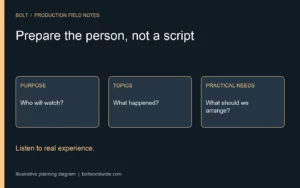
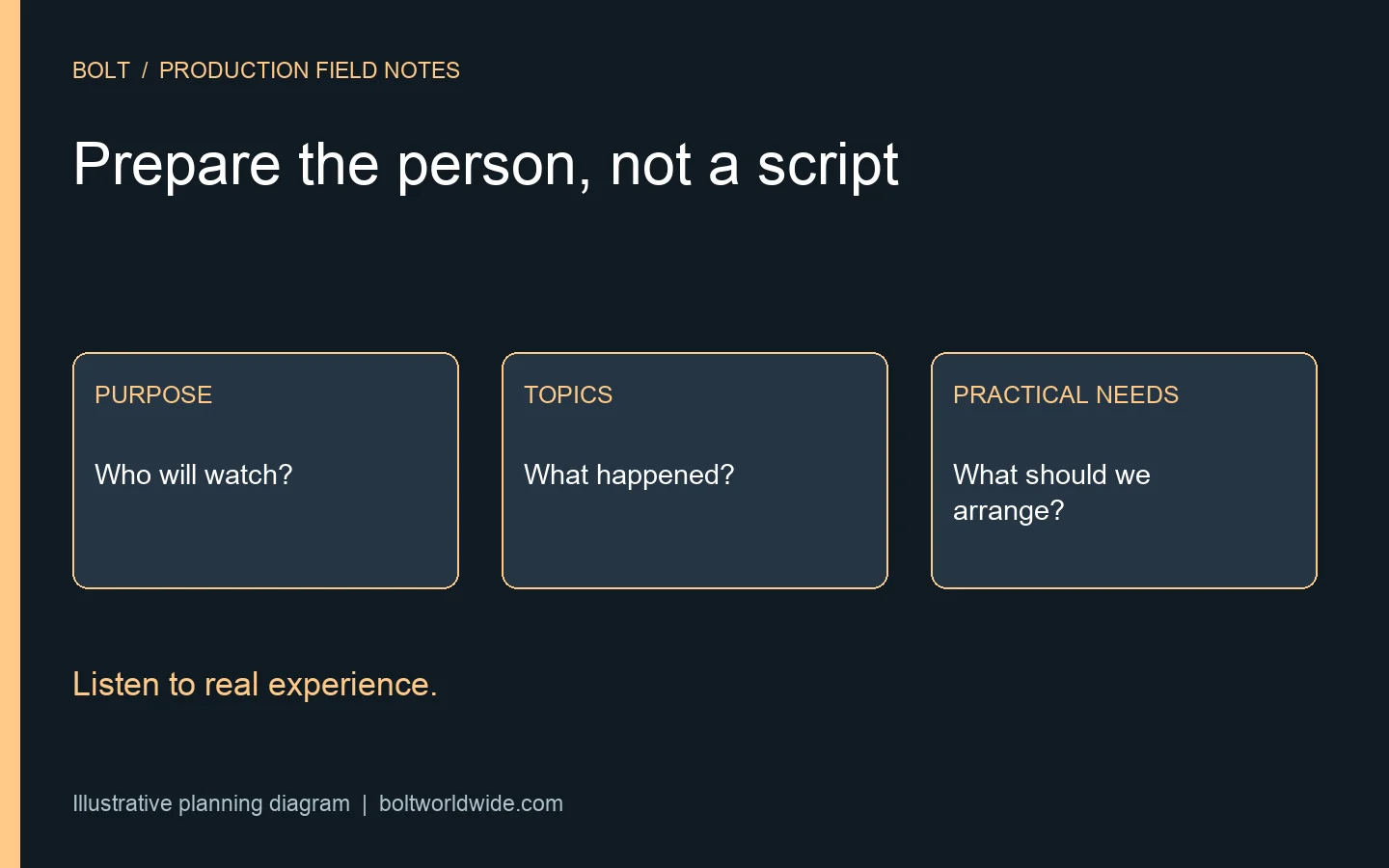
Prepare employees for a video interview by explaining why they are being filmed, who will watch and which experiences the interviewer wants to understand. Share topics and practical shoot details, check the facts that need confirmation and give people a way to raise questions. Prepare the person for the conversation without turning their answers into memorized company copy.
This guide is for the brand or communications team coordinating employee participation. It addresses what to send, discuss and organize before filming. Choosing a customer story and checking the final edit are different decisions, covered in our testimonial production guide and testimonial cut review.
Explain the purpose before asking for preparation
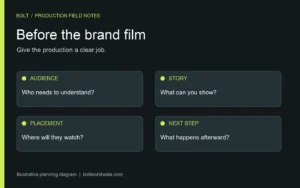
Tell the participant what the film is intended to help someone understand. Name the audience and likely viewing settings. A conversation about daily work for a recruitment film differs from an explanation of a product decision for a customer. Give the employee enough context to understand why their experience matters without implying they must provide a predetermined endorsement.
ScreenSkills’ interview preparation guidance recommends explaining the purpose, intended topics and audience to the interviewee. Use that preparation to establish understanding, not to rehearse a preferred conclusion. Ask what the employee knows firsthand and which parts of the proposed discussion should go to someone else.
For a recruitment video, identify the actual job experiences the participant can explain. Keep their individual experience distinct from a promise about what every employee will encounter. An interview can reveal a useful perspective without standing in for the whole organization.
Send topics and context rather than polished answers
Give the participant a short list of areas the interviewer hopes to explore. Ask them to recall a specific situation, the action they took and what they learned. Invite them to check dates, names or technical details that could otherwise become uncertain on camera. If supporting material exists, tell the producer where it can be reviewed appropriately.
Avoid circulating a script that asks the employee to speak as though promotional language were their personal experience. If a sentence must be delivered exactly as an official company statement, discuss that as a scripted presentation with the production team. A factual interview and a prepared spokesperson statement can each be useful, but the participants and reviewers should understand which assignment they are making.
Agree what should stay outside the conversation
Ask the relevant company reviewers to identify confidential material, customer details or unannounced information that should not be discussed. Make those boundaries understandable to the participant and interviewer. Do not rely on a hurried instruction immediately before recording to resolve uncertainty about what can be said.
Explain who handles participation questions and the intended use of the recording. Coordinate any permissions through the appropriate company process. Give the person a way to flag discomfort or a question before filming, and clarify how changes in availability are handled. These are production coordination steps, not a substitute for the organization’s own participation policies or review responsibilities.
Give the employee a realistic picture of the shoot
Share the confirmed arrival details, location contact, planned interview window and any other activities expected that day. Distinguish a confirmed schedule from a provisional plan. If supporting footage will include the person’s work, tell them what has been arranged and what still depends on access or another team’s approval.
Have the producer provide clothing or appearance guidance suited to the actual location and visual treatment. Avoid turning general internet advice into rigid rules without knowing the setup. Ask about practical access or communication needs early enough for the production team to plan. Keep any personal information shared for those arrangements limited to the people who need it.
The production brief should identify the interview purpose and participant requirements alongside the rest of the assignment. A comfortable room is not enough if the employee was told to prepare for an entirely different conversation.
Brief the interviewer on experience and uncertainty
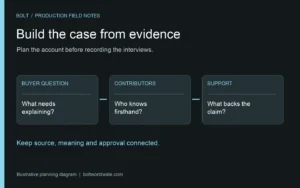
Give the producer relevant context from the preparation conversation. Note which experiences the person can explain, where the account needs another source and which questions remain unresolved. Share useful background without describing the employee as difficult merely because they questioned a claim or corrected the proposed story.
Ask the interviewer to use open questions and listen to the response rather than insist on a fixed sequence. A preparation call can surface a better line of inquiry. It should not become a secret answer key against which the filmed conversation is graded. Keep the participant’s account and the company’s desired message visible as separate inputs to the editorial process.
Leave room for pauses, corrections and a clearer question
Explain that the production team can pause when someone needs a moment, a question is unclear or a distraction interrupts the answer. The interviewer can ask the question again when necessary. Avoid promising a particular editing outcome before the producer has assessed the material and agreed the review process.
If a participant does not know an answer, record that uncertainty and find the appropriate source afterward. Do not ask for a confident version of a statement whose facts are still unsettled. A useful interview gives the editor material with clear meaning and context. A smooth delivery does not turn an unsupported statement into evidence.
Connect participation to the rest of production
Plan supporting footage around what has actually been arranged. Someone describing a process does not establish that the crew can film it, enter a restricted area or include another person’s work. Bring the access and schedule questions into pre-production planning so the interview and the pictures can be developed together.
For editorial references, review work in the Alberto Blanco director portfolio to discuss visual tone. A reference is not a promise to reproduce another project’s circumstances. Keep the participant’s actual contribution at the center of the brief rather than fitting their account to an unrelated example.
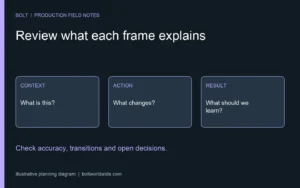
What should an employee receive before filming?
Send the purpose, audience, intended topics, location and schedule details, preparation contact and any approved information boundaries. Explain whether the session is an interview, scripted delivery or a combination. Ask the employee to flag factual uncertainty and practical needs before the shoot rather than prepare a performance that hides them.
What if someone sounds rehearsed?
Ask about a specific experience in their own terms and listen for the detail behind a general statement. Discuss any need for exact official wording as a separate scripted element. Do not manufacture spontaneity or edit a qualification away to make the answer sound more enthusiastic.
Email brian@boltworldwide.com with the audience, participant roles and intended film. A clear preparation plan gives the production team a real conversation to record.