
Previsualization is worth discussing when a production decision is difficult to judge from a written treatment alone. Use rough images, a timed sequence or a camera-blocking test to answer a specific question about framing, movement or the proposed environment. Agree what the test must establish, what remains provisional and how the result will change the actual shoot plan.
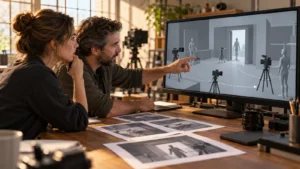
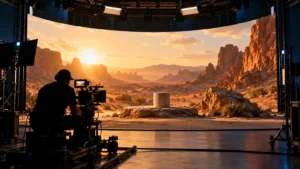
Illustrative generated image. This scene does not depict Bolt personnel, facilities or client work.
Previsualization, often shortened to previs, is planning material created before the final footage. It can help a team examine a proposed scene without pretending that a rough representation is the finished film. The commissioning decision is whether that extra planning work answers something important that simpler preparation cannot.
Start with the uncertainty, not the visual polish
Write down the decision you cannot yet make. Perhaps a camera move must reveal a product while a performer crosses the set. Perhaps several departments interpret the proposed environment differently. Or the scene depends on a transition that is easy to describe but hard to imagine consistently.
Ask what would change if the test showed that the idea did not work. If the answer concerns a build, a location choice, a complex movement or the sequence of a shoot, the question deserves an explicit planning conversation. If everyone already understands a straightforward scene, more elaborate visual development may add little. Do not commission a presentation simply because its finish would impress a review group.
Keep the audience and story decision connected to that production question. Our brand film treatment review covers whether the proposed scenes support the message. Previs should investigate how an unsettled scene could be made, rather than reopen the entire creative idea without a reason.
Match the planning format to the question
A concept image can help discuss an environment or visual direction. A sequence of frames can show the order of important moments. A rough timed edit can expose pacing questions. A simple spatial or camera-blocking test can help the team discuss where people and cameras might move. These materials answer different questions, so specify the decision before choosing the format.
For a hypothetical product reveal, a polished still may communicate the intended mood but say little about whether the camera can move through the proposed space. A rough blocking test could be more useful for that question. Conversely, a moving grey scene may leave color, texture and the final visual character unresolved. Ask the production team to identify the smallest useful test.
If an animation storyboard is already the agreed review format, use the animation storyboard review guide for that stage. Previsualizing a live-action scene is a separate commissioning choice. It should have its own stated purpose instead of borrowing an approval label from a different process.
Make assumptions visible in the review
List the conditions represented in the planning material. Does the proposed space reflect a measured location or an imagined one? Are people represented by stand-ins? Is the product shown at an approximate scale? Which parts of the environment would be filmed, built or added later?
Do not let an image imply those questions are settled. A persuasive representation can hide an impossible camera position or a product detail that the company has not approved. Ask the producer and relevant specialists which assumptions need checking before the material influences a commitment. Record the question with the scene it affects.
The same discipline applies when a planning image is generated or composited. Label it as a reference and identify what it is intended to communicate. Do not treat a generated person’s appearance as approved casting, a depicted product as verified engineering or an imagined location as an available space. Keep planning references separate from assets authorized for the final film.
Give reviewers a decision they can actually make
Explain what each review is intended to settle. You might ask whether a reveal communicates the right idea, whether the planned order of actions is understandable or whether a proposed environment fits the story. Separate those questions from final lighting, performance, surface detail or finishing choices that the material does not demonstrate.
Ask for feedback tied to a visible moment. “The viewer cannot see the product before the person moves across it” gives the team a problem to investigate. “Make it more cinematic” does not identify which production assumption should change. Invite the director or producer to propose an adjustment instead of asking every reviewer to design a different shot.
Use the video approval workflow to name the company decision-maker and consolidate comments. Agreement on a planning reference should not drift into approval of everything a finished film might contain.
Translate the result into a production consequence
A useful review ends with a changed or confirmed decision. Identify the selected approach, the alternatives rejected and the assumptions that still need testing. Then ask who will carry those decisions into the shot list, location preparation, art direction, crew discussion and schedule.
Keep the approved reference version attached to that record. If the design changes afterward, name the affected production decisions instead of circulating a new image with no explanation. Our agency handoff guide addresses the wider transfer from creative work into production. The previs result should become part of that transfer, not a separate presentation everyone remembers differently.
If the scene involves an LED stage, a replacement background or another technical approach, the stage and location comparison explains questions to bring into the production discussion. A planning image alone cannot verify the actual equipment, camera test or physical conditions.
Set a boundary for the extra planning work
Ask which scenes need investigation and which do not. Define the material expected, who reviews it and what happens if the first approach is rejected. Discuss the effect of changing an already accepted production decision. Avoid treating an open-ended search for a preferred look as a small, fixed task.
The appropriate effort depends on the question and the project. Do not assume previs will produce a particular saving, shorten every schedule or prevent every surprise. Its value here is that the team can inspect a defined uncertainty and decide what to do with what it learns.
Is previs the same as a finished animation?
No. A rough planning sequence may use animation without being a final animated deliverable. Confirm its intended use and the decisions it can support. Production, performance, technical checks and final viewing review remain separate responsibilities.
Does every corporate video need previsualization?
No. Start with the complexity of the scene and what remains unclear. A clear treatment, ordinary planning references or a rehearsal may answer the question. Discuss additional previs only when the team can explain what decision it would help resolve.
Email brian@boltworldwide.com with the scene, the unresolved question and the planning material you already have. Discuss the appropriate preparation and scope with Bolt’s pre-production team before making the shoot depend on an untested visual assumption.